PDF Download Software Optimization for High Performance Computing: Creating Faster Applications
This Software Optimization For High Performance Computing: Creating Faster Applications comes to be a complement in your preparation for better life. It is to needed to obtain the book to acquire the very best seller or best writer. Every publication has particular making you feel deeply concerning the message and impression. So, when you discover this book in this site, it's far better to obtain this publication soon. You can see exactly how a straightforward book will certainly provide effective impression for you.
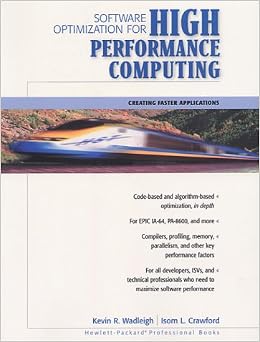
Software Optimization for High Performance Computing: Creating Faster Applications

PDF Download Software Optimization for High Performance Computing: Creating Faster Applications
Be one of the fortunate individuals who get guide from a famous writer now. Please welcome Software Optimization For High Performance Computing: Creating Faster Applications Yeah, this is a kind of popular publication to be best seller and upgraded now. When you have handle this type of topic, you have to get it as your resource. This is not only a book that you require, yet additionally a book that is so interesting.
Yet, this is not kind of sacral advice. Publication could aid you resolve as well as from the problem, yet, it can't make a decision just how you will address it. It will certainly not offer you the guarantee. You are the one that should take it. When taking guide excels method, it will certainly look to be absolutely nothing when you do not read it well. Having Software Optimization For High Performance Computing: Creating Faster Applications will certainly mean absolutely nothing when you can't use the content and learning from this publication.
From guide, you will certainly realize that analysis is absolutely had to do. It will certainly guide you to get more precious hanging out. By checking out guides, your hung out will certainly not waste inaccurately. You could find exactly what you need and want to observe. Right here, the Software Optimization For High Performance Computing: Creating Faster Applications ends up being a choice to check out the book due to the fact that it provides you the amazing attributes of the life. Even it is just the rep are for getting this sort of book, you might see exactly how you can appreciate the book exactly.
Just connect to the web to get this book Software Optimization For High Performance Computing: Creating Faster Applications This is why we indicate you to utilize and also make use of the developed technology. Checking out book doesn't suggest to bring the printed Software Optimization For High Performance Computing: Creating Faster Applications Established technology has permitted you to read just the soft data of the book Software Optimization For High Performance Computing: Creating Faster Applications It is same. You could not have to go as well as get traditionally in searching guide Software Optimization For High Performance Computing: Creating Faster Applications You may not have adequate time to spend, may you? This is why we provide you the best way to obtain guide Software Optimization For High Performance Computing: Creating Faster Applications currently!
Review
"(This) is a book that should be in the hands of programmers in high-performance computing."—Greg Astfalk, Chief Scientist, Technical Computing Division, Hewlett-Packard Company.
Read more
From the Inside Flap
Preface Once you start asking questions, innocence is gone. - Mary Astor This purpose of this book is to document many of the techniques used by people who implement applications on modern computers and want their programs to execute as quickly as possible. There are four major components that determine the speed of an application: the architecture, the compiler, the source code, and the algorithm. You usually don't have control over the architecture you use, but you need to understand it so you'll know what it is capable of achieving. You do have control over your source code and how compilers are used on it. This book discusses how to perform source code modifications and use the compiler to generate better performing applications. The final and arguably the most important part is the algorithms used. By replacing the algorithms you have or were given with better performing ones, or even tweaking the existing ones, you can reap huge performance gains and perform problems that had previously been unachievable. There are many reasons to want applications to execute quickly. Sometimes it is the only way to make sure that a program finishes execution in a reasonable amount of time. For example, the decision to bid or no-bid an oil lease is often determined by whether a seismic image can be completed before the bid deadline. A new automotive body design may or may not appear in next year's model depending on whether the structural and aerodynamic analysis can be completed in time. Since developers of applications would like an advantage over their competitors, speed can sometimes be the differentiator between two similar products. Thus, writing programs to run quickly can be a good investment. P.1 A Tool Box We like to think of this book as a tool box. The individual tools are the various optimization techniques discussed. As expected, some tools are more useful than others. Reducing the memory requirements of an application is a general tool that frequently results in better single processor performance. Other tools, such as the techniques used to optimize a code for parallel execution, have a more limited scope. These tools are designed to help applications perform well on computer system components. You can apply them to existing code to improve performance or use them to design efficient code from scratch. As you become proficient with the tools, some general trends become apparent. All applications have a theoretical performance limit on any computer. The first attempts at optimization may involve choosing between basic compiler options. This doesn't take much time and can help performance considerably. The next steps may involve more complicated compiler options, modifying a few lines of source code, or reformulating an algorithm. The theoretical peak performance is like the speed of light. As more and more energy, or time, is expended, the theoretical peak is approached, but never quite achieved. Before optimizing applications, it is prudent to consider how much time you can, or should, commit to optimization. In the past, one of the problems with tuning code was that even with a large investment of a time the optimizations quickly became outdated. For example, there were many applications that had been optimized for vector computers which subsequently had to be completely reoptimized for massively parallel computers. This sometimes took many person-years of effort. Since massively parallel computers never became plentiful, much of this effort had very short-term benefit. In the 1990s, many computer companies either went bankrupt or were purchased by other companies as the cost of designing and manufacturing computers skyrocketed. As a result, there are very few computer vendors left today and most of today's processors have similar characteristics. For example, they nearly all have high-speed caches. Thus, making sure that code is structured to run well on cache-based systems ensures that the code runs well across almost all modern platforms. The examples in this book are biased in favor of the UNIX operating system and RISC processors. This is because they are most characteristic of modern high performance computing. The recent EPIC (IA64) processors have cache structures identical to those of RISC processors, so the examples also apply to them. P.2 Language Issues This book uses lots of examples. They are written in Fortran, C, or in a language-independent pseudocode. Fortran examples use uppercase letters while the others use lowercase. For example, DO I = 1,NY(I) = Y(I) + A * X(I)ENDDO takes a scalar A, multiplies it by a vector x of length N and adds it to a vector Y of length N. Languages such as Fortran 90/95 and C++ are very powerful and allow vector or matrix notation. For example, if x and Y are two-dimensional arrays and A is a scalar, writing Y = Y + A * X means to multiple the array x by A and add the result to the matrix Y This notation has been avoided since it can obscure the analysis performed. The notation may also make it more difficult to compilers to optimize the source code. There is an entire chapter devoted to language specifics, but pseudo-code and Fortran examples assume that multidimensional arrays such as Y (200, 100) have the data stored in memory in column-major order. Thus the elements of Y (200, 100) are stored as Y(1,1), Y(2,1), Y(3,1),..., Y(200,1), Y(1,2), Y(1,3),... This is the opposite of C data storage where data is stored in row-major order. P.3 Notation When terms are defined, we'll use italics to set the term apart from other text. Courier font will be used for all examples. Mathematical terms and equations use italic font. We'll use lots of prefixes for the magnitude of measurements, so the standard ones are defined in the following table.Table P-1: Standard PrefixesPrefix Factor Factortera 1012 240giga 109 230mega 106 220kilo 103 210milli 10-3micro 10-6nano 10-9 Note that some prefixes are defined using both powers of 10 and powers of two. The exact arithmetic values are somewhat different. Observe that 106 = 1,000,000 while 210 = 1,048,576. This can be confusing, but when quantifying memory, cache, or data in general, associate the prefixes with powers of two. Otherwise, use the more common powers of 10. Finally, optimizing applications should be fun. It's really a contest between you and the computer. Computers sometimes give up performance grudgingly, so understand what the computer is realistically capable of and see that you get it. Enjoy the challenge!
Read more
See all Editorial Reviews
Product details
Paperback: 377 pages
Publisher: Prentice Hall; 1 edition (May 28, 2000)
Language: English
ISBN-10: 0130170089
ISBN-13: 978-0130170088
Product Dimensions:
7 x 1 x 9 inches
Shipping Weight: 1.4 pounds
Average Customer Review:
3.7 out of 5 stars
4 customer reviews
Amazon Best Sellers Rank:
#1,544,114 in Books (See Top 100 in Books)
My background is from 20 years of experience in high performance computing conducted in the academic, national lab, and comercial realms. I can say that this is a very enjoyable and entertaining book.There once was a time when a programmer could look at several algorithms, and decide the ones they want to use based on an analysis of the operations that were performed, those simple times are over and have been over for many years. Now, detailed attention also has to be paid to the overall system architecture, particularily the cache locality of the chosen approach. This book introduces a mental tool set to determine how to best make these tradeoffs for your application and system. The book does a good job in hammering home the point that O(n) analysis by itself no longer cuts it. You have to know how big your cache lines are and make sure you use them. If I had my way, every new hire out of college would be forced to read this book before they ever allowed to utter the words "Stassen algorithm".I didn't give it a five because as another reviewer pointed out it is a bit rocky in parts, and the underlying analytic processes which the authors were following have to be tweaked out by the reader. None the less, procuring and reading this book was time and money well spent.
I don't wish to offend the authors of this book, who I am sure are experts in this field. However, I found this book to be unnecessarily difficult to read.The the book presents inherently complex material, which testifies to the proficiency of the authors. However, it was often not clear what point the authors were trying to make, especially regarding graphs which lacked clear explanations. Often I had to to re-read an entry several times before I understood what the authors were trying to express.I am sure the book contains a wealth of valuable information (which is why I ordered it), but I personally was unwilling to invest the time and energy necessary to fathom the authors intent.I am a systems engineer for an international telecom company.
I am a physics graduate student and taking a graduate course on programming parallel machines. This course is offered by an electrical and computer engineering professor at our university.This course covers computer architectures (SMP, NUMA, et al.), theory on parallelism, OpenMP, MPI, Pthreads, and various research tools. I found this book by Drs. Wadleigh and Crawford very helpful for me to go through the entire semester.This book follows three important core issues on high performance computing. Part I includes hardware overview and basic parallel programming methodologies. I found this part help me a lot to catch the backgrounds that I don't previously have. Part II deals with several issues on software techniques. Part II lists the tools, algorithms, and applications such as LAPACK, and fast Fourier transform.I would highly recommend this book to scientists and engineers in the areas of computational science and engineering applications. I am so glad that our physics library has ordered and placed this book on the new bookshelf.Written by sjtu from computational neutrino physics and geometric probability research group.
Wadleigh and Crawford have collected, organized, and presented a great deal of useful information for anyone who wants to obtain high-end performance on modern, high-end computer systems. I appreciate how the book explains and compares the approaches of various computer vendors in high-end systems, providing some historical context along the way. Along with explanations, the authors have included numerous, relevant examples (high-level & assembly source, tables of test results) to illustrate the key factors that contribute to application performance.I think this book could easily be made into, or used with, a short course/overview on high performance computing.
Software Optimization for High Performance Computing: Creating Faster Applications PDF
Software Optimization for High Performance Computing: Creating Faster Applications EPub
Software Optimization for High Performance Computing: Creating Faster Applications Doc
Software Optimization for High Performance Computing: Creating Faster Applications iBooks
Software Optimization for High Performance Computing: Creating Faster Applications rtf
Software Optimization for High Performance Computing: Creating Faster Applications Mobipocket
Software Optimization for High Performance Computing: Creating Faster Applications Kindle

SOCIALIZE IT →